

NEURO NEWS
MS "Gamechanger"
24 October 2025
A biology teacher from Hertfordshire has become the first patient in the UK to receive a “gamechanger” trial therapy to treat multiple sclerosis (MS).
The CAR T-cell treatment, which experts believe could “transform” lives by halting or slowing down progression of the disease, is custom-built for each patient in the lab.
The person’s own T cells, which are crucial for hunting out infected or damaged cells, are genetically engineered by scientists and fed back into the patient via an infusion to “re-set” the immune system. CAR T for MS modifies the T cells to recognise and kill B cells, which are known to cause damage and allow MS to advance.
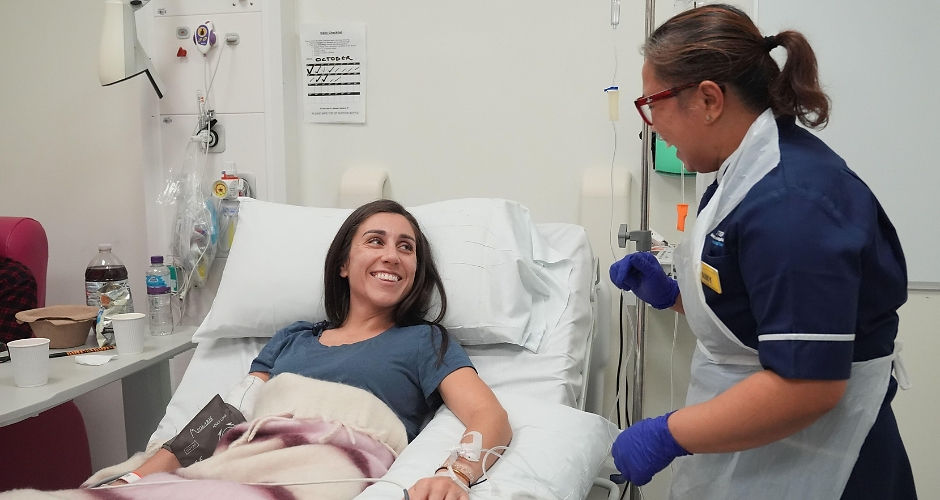
Emily Henders, 37, from Bushey, Hertfordshire, recently received her CAR T at University College London Hospital (UCLH) as part of a global clinical trial into whether it can treat MS.
Mrs Henders was diagnosed with MS in December 2021 after suffering tingling in her hands. Her father has the condition and she was aware what the symptoms could indicate.
Since being told she has MS, Mrs Henders has suffered four debilitating relapses, despite taking one of the most highly effective medications for the disease.
“Physically, my symptoms have progressively got worse,” she said. “I notice sometimes my foot hits the pavement in a funny way. No-one else would notice it, but I feel it.
“When I’m having a relapse, not being able to move my legs means I can’t get around the house, I can’t help with the kids, I can’t drive, and then that puts an impact on everybody around me as well.”
Mrs Henders said a good outcome of CAR T-cell therapy for her would be to “never experience a relapse again”, though “obviously the ideal would be a cure.”
According to UCLH consultant haematologist, Claire Roddie, CAR T-cell offers real hope for MS patients and has shown success in cancer and the autoimmune disease lupus.
“Our ultimate goal is to achieve long periods of disease remission with a single, one-time CAR T-cell treatment,” she said, adding it could mean people can come off all their other drugs.
“We are excited about this because we’re taking a treatment developed to treat cancers and re-purposing it for a whole new spectrum of conditions. CAR T-cells also go to places in the body that other drugs don’t necessarily get to very effectively.
“If you’ve got multiple sclerosis, and the cells that are driving that multiple sclerosis are sitting somewhere in your nervous system or around your nerves, it’s quite difficult for regular drugs to get there, to deplete them.
“So CAR T-cells offer a really, sort of tangible potential solution. The concept here is that we give this CAR T-cell therapy, this ‘one and done’ – bang, you’re in, you get the treatment, and that’s it. And hopefully you don’t need any more drugs beyond that time point. If we could achieve that in MS, it would transform so many people’s lives.”
Dr Wallace Brownlee, consultant neurologist and clinical lead for the multiple sclerosis service at the National Hospital for Neurology and Neurosurgery, as well as principal investigator on the trial, says that current MS treatments require ongoing tablets or injections or trips to hospital.
“CAR T-cell therapy is an exciting new frontier in the treatment of autoimmune conditions,” he said, adding that the “real promise” of CAR T-cell therapy is that it can be given just as a single treatment, potentially freeing people from a future of needing to take immunosuppressants.
The trial aims to recruit up to 18 patients globally by early 2027.